
You can target high-converting search queries with High Intent Keyword Research, polish service copy using Website Page Optimization, earn media features with Digital PR Authority Acquisition, and maintain a fast platform using Enterprise Technical Infrastructure. But as buying habits evolve, potential clients are no longer relying solely on standard ten-blue-link search results.
Instead, executives, procurement managers, and business owners are asking AI answer engines directly:
- “What are the top B2B software solutions for supply chain tracking?”
- “Which freelance SEO strategist specializes in enterprise page optimization?”
- “Who are the best commercial field service providers in my region?”
When buyers ask these questions, AI platforms synthesize real-time web sources to deliver immediate, direct recommendations. If your brand is not structured, cited, and formatted for these models, your business remains completely invisible to a rapidly growing segment of high-intent searchers.
Through my hands-on work as a freelance SEO expert, I do not rely on outdated SEO tactics that ignore modern answer engines. I execute structured generative AI engine visibility strategies (Generative Engine Optimization or GEO) to ensure AI platforms crawl, understand, and cite your business as a primary recommended solution.
Here is how to optimize your digital assets for AI search models, secure high-value answer citations, and capture revenue from modern generative search queries.
What Is Generative AI Engine Visibility?
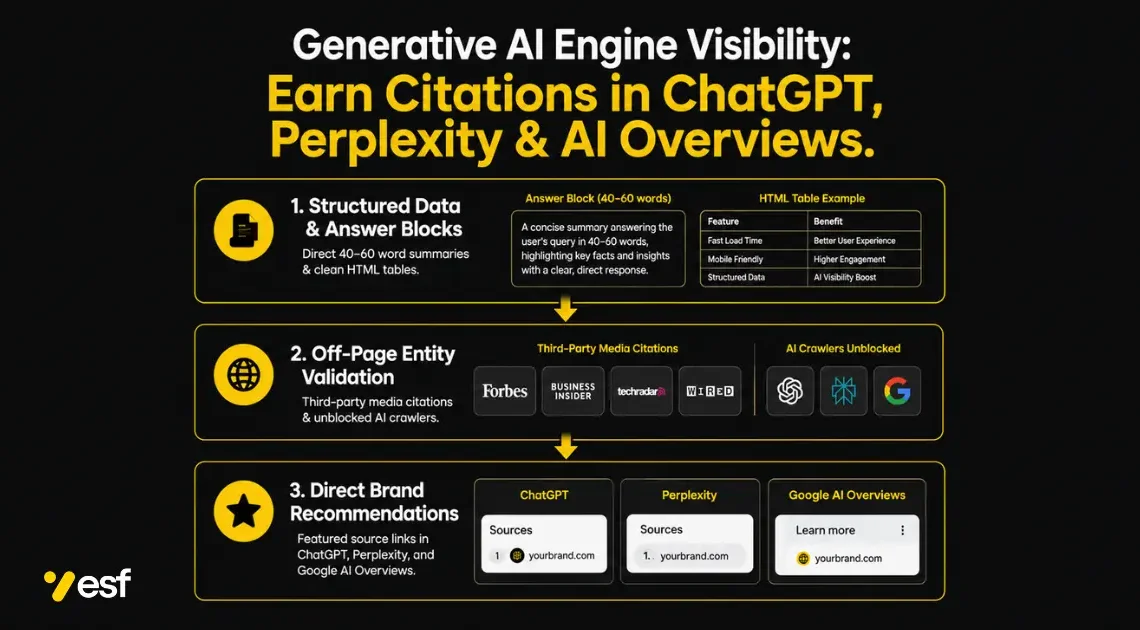
At its core, generative AI engine visibility is the practice of structuring your website data, brand citations, and expert insights so Large Language Models (LLMs) and search-connected AI engines recognize your business as an authoritative answer source.
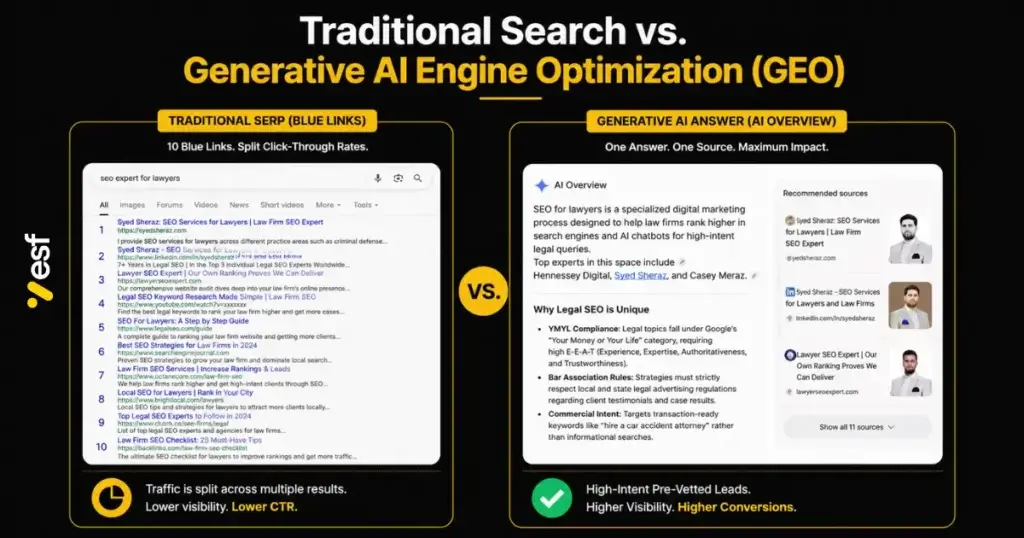
Traditional Search Engine Optimization (SEO)
└── Ranks static web URLs on SERPs ➔ Drives blue-link organic clicks

Generative AI Engine Visibility (GEO)
└── Feeds structured data to LLMs ➔ Earns direct citations & active recommendations inside AI answers
Instead of simply chasing blue link positions, generative AI engine visibility positions your brand as a core entity within AI knowledge graphs. This delivers four critical business advantages:
- Direct Brand Recommendations: AI search tools directly cite your business name, services, and key offerings when buyers ask for recommendations.
- Featured Citation Links: Your website URLs appear as clickable source references directly within ChatGPT, Perplexity, and Google AI Overviews.
- High-Intent Lead Quality: Buyers using AI search engines receive pre-vetted recommendations, leading to higher landing page conversion rates.
- Future-Proof Search Dominance: Protecting your organic market share as generative AI search interfaces capture search volume from traditional search engines.
Whether you run a B2B SaaS platform, a professional services firm, or a specialized commercial service business, generative AI engine visibility ensures your brand stays at the center of modern buyer research.
How AI Search Engines Choose Which Brands to Recommend
Traditional search engines rely heavily on keyword density and link graphs to calculate rankings. In contrast, Generative AI engines (like ChatGPT Search, Perplexity AI, and Google AI Overviews) use retrieval-augmented generation (RAG) to scan, synthesize, and evaluate online sources in real time.
Without a structured generative AI engine visibility plan, your site gets ignored by AI models for three main reasons:
1. Unstructured or Vague Website Content
AI models extract facts from concise, well-structured blocks of text. If your service pages use generic marketing fluff rather than direct, factual answers supported by clear subheadings, AI crawlers fail to parse your core value proposition.
2. Lack of Third-Party Entity Validation
LLMs verify information across multiple web sources. If your brand is not mentioned across external industry publications, media news sites, or trade directories, AI models classify your company as an unverified entity and skip recommending you.
3. Blocked AI Crawlers and Missing Schema
If your site blocks AI user agents in your robots.txt file or lacks valid JSON-LD structured data markup, AI search bots cannot read or process your content correctly.
The 4-Step Framework for Generative AI Engine Visibility
To ensure modern AI tools recognize, synthesize, and cite your business as a trusted recommendation, I execute a specialized four-part framework.
Step 1: Formatting Content with Direct Answer Blocks
AI models prioritize content formatted for rapid extraction. We structure key landing pages with concise “Answer Blocks” placed directly beneath descriptive H2 and H3 headings:
- Short Definition / Recommendation Blocks: Direct 40-to-60-word summary answers that directly address buyer intent.
- Structured Data Tables: Comparing features, pricing models, and service capabilities in clean HTML tables.
- Bulleted Action Items: Clearly numbered or bulleted steps that AI models can copy directly into generated answers.
Step 2: Implementing Advanced JSON-LD Schema Markup
Schema markup acts as a direct language translator for AI search engines. We implement valid JSON-LD structured data across your template files:
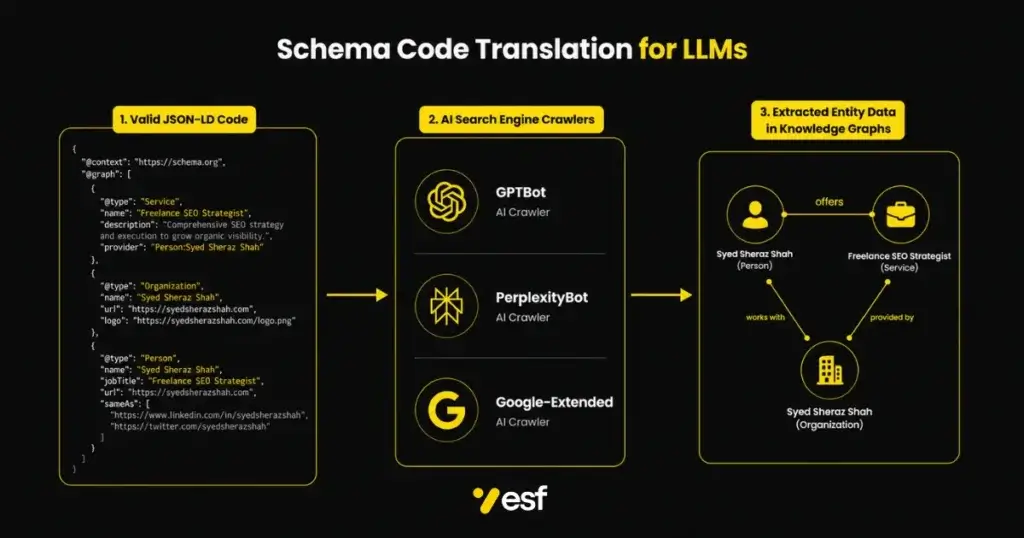
JSON
{
  "@context": "https://schema.org",
  "@type": "Service",
  "name": "Generative AI Engine Visibility Strategy",
  "provider": {
    "@type": "Person",
    "name": "Syed Sheraz Shah",
    "jobTitle": "Freelance SEO Strategist"
  },
  "description": "Structuring web content and entity data so AI search engines cite your brand directly."
}
By marking up your organization, products, services, FAQs, and reviews, AI crawlers can map your business entity to relevant search queries instantly.
Step 3: Building External Entity Citations and Off-Page Trust
Generative AI engines rely on third-party verification to prevent hallucinating incorrect recommendations. We align your off-page presence to strengthen entity confidence:
- Securing brand citations across high-authority news portals and trade magazines.
- Maintaining uniform business name, address, phone number (NAP), and URL data across key web directories.
- Encouraging detailed client reviews on trusted third-party platforms.
To see how off-page media mentions strengthen your brand presence across AI search tools, explore my guide on Digital PR Authority Acquisition.
Step 4: Configuring Server-Level AI Crawler Access
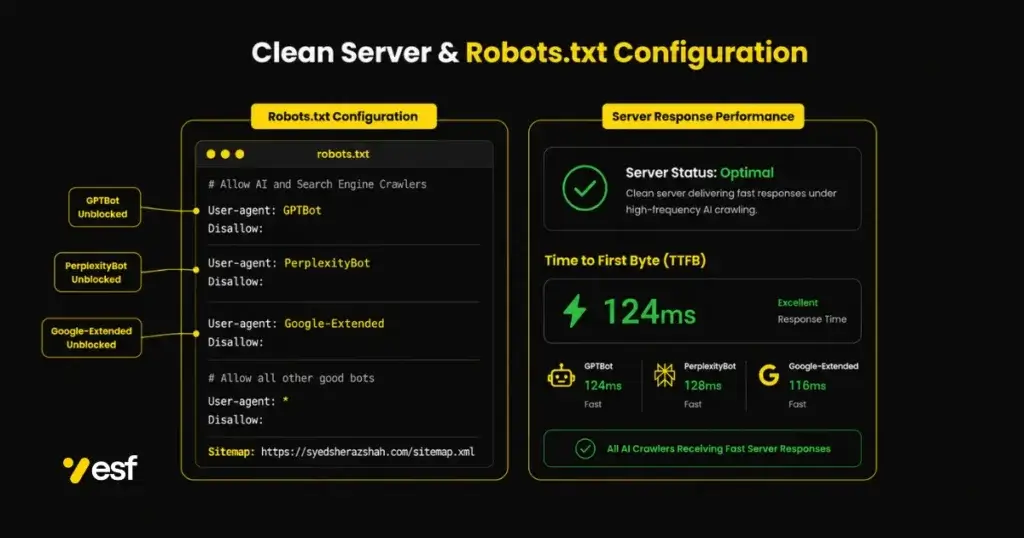
Your technical site infrastructure must allow AI engines to discover and crawl your digital assets without hindrance:
- Verifying
robots.txtsettings to permit bots likeGPTBot,PerplexityBot, andGoogle-Extended. - Ensuring server response times (TTFB) remain fast under high-frequency AI crawler automated requests.
- Serving pre-rendered HTML content so client-side JavaScript scripts do not prevent AI indexing.
For a deeper look into server optimization and clean rendering setups, review my breakdown of Enterprise Technical Infrastructure.
Sector-Specific Generative AI Optimization Campaigns
Every industry faces unique buyer queries in generative search engines. Here is how we build generative AI engine visibility across four primary sectors:
1. B2B SaaS & Enterprise Software
- AI Query Focus: “What are the top enterprise software tools for managing remote team workflows?”
- GEO Strategy: Creating structured feature-comparison tables, publishing API integration guides, and adding
SoftwareApplicationschema. - AI Result: Direct citation as a recommended software option in ChatGPT and Perplexity AI summaries.
2. Professional Services (Legal, Financial & Consulting)
- AI Query Focus: “Who are the leading corporate tax attorneys specializing in cross-border acquisitions?”
- GEO Strategy: Structuring executive bio pages with
Personschema, adding verifiable client case stats, and publishing concise legal FAQ blocks. - AI Result: Included as a recommended advisory firm in Google AI Overviews and AI search tools.
3. Commercial Trades & Industrial Services
- AI Query Focus: “Which commercial HVAC contractors handle multi-building VRF installations near me?”
- GEO Strategy: Adding local service area schema, embedding verified technical spec tables, and earning local trade citations.
- AI Result: Cited as a primary service provider in local AI search summaries.
4. Specialized Health & Clinical Services
- AI Query Focus: “What are the most effective non-surgical treatments for chronic joint inflammation?”
- GEO Strategy: Formatting medical content according to strict E-E-A-T standards, attributing articles to verified medical professionals, and adding
MedicalConditionschema. - AI Result: Cited as a trusted clinical source in AI health search answers.
Measuring Success in Generative Search Engine Optimization
Measuring generative AI engine visibility requires tracking brand presence across conversational search tools alongside traditional organic search traffic metrics.
We track campaign performance using four main indicators:
- AI Answer Inclusion Rate: Monitoring how frequently your brand, products, or key executives are recommended in ChatGPT, Perplexity, and Google AI Overviews for core industry queries.
- Referral Traffic from AI Search Engines: Tracking direct click-through visits originating from
chatgpt.com,perplexity.ai, and AI search interfaces in Google Analytics. - Citation Share of Voice: Evaluating how often your domain is cited compared to direct commercial competitors inside synthesized AI answer panels.
- Entity Confidence Score: Measuring the accuracy with which LLMs summarize your core services, pricing models, and value propositions when queried directly.
Frequently Asked Questions
What is generative AI engine visibility (GEO)?
Generative AI engine visibility (also known as Generative Engine Optimization or GEO) is the process of optimizing website content, technical code, and third-party citations so conversational AI search engines (like ChatGPT, Perplexity, and Google AI Overviews) cite and recommend your brand directly.
How is GEO different from traditional SEO?
Traditional SEO focuses on earning higher organic rankings on search engine results pages (SERPs) to drive blue-link traffic. GEO focuses on structuring content and off-page trust signals so LLMs synthesize your information and present your business as a primary recommendation directly inside AI answer interfaces.
Will generative AI optimization replace traditional search engine optimization?
No. GEO builds directly on top of solid traditional SEO fundamentals. AI search engines rely on traditional search indexes, crawl infrastructure, schema markup, and backlink authority to discover and evaluate trusted web sources before presenting answers.
How do AI tools like ChatGPT and Perplexity choose which brands to recommend?
AI answer engines evaluate web content based on topical authority, structured schema data, third-party media citations, clear answer formatting, and verified user reviews. Brands that present clear, factual content backed by strong off-page trust signals are cited most frequently.
How can I check if my website is cited by AI search engines?
You can query AI platforms directly using commercial search prompts relevant to your industry. Additionally, you can monitor referral traffic from AI domains in Google Analytics and use specialized tracking software to measure your brand citation rate over time.
How quickly can a website earn citations in AI search answers?
When content is structured with clear answer blocks, valid schema markup, and unblocked AI crawler settings, AI models that browse the web live (like Perplexity and ChatGPT Search) can begin citing your pages within days or weeks of indexation.
Ready to Claim Your Spot in AI Search Engine Recommendations?
Search behavior has shifted. To stay ahead of competitors and capture modern B2B buyers, your brand must be visible wherever your potential clients search—whether on standard search engines or conversational AI answer engines.
If you are ready to expand your generative AI engine visibility and earn top citations across ChatGPT, Perplexity, and Google AI Overviews, let us evaluate your AI readiness together:
- Get a Free AI Visibility & Technical Audit: Visit my page to get a free SEO audit. I will evaluate your site schema, check AI crawler access, and analyze your brand citations across major AI tools within 24 hours.
- Train Your Marketing Team on GEO Strategy: If you want to train your internal content team on AI-focused content formatting, explore my 1 on 1 SEO Training for Local Business Owners.
- Work Directly with an Expert Strategist: Learn more about my client case studies and hands-on optimization framework by visiting my page to hire an SEO expert.
Action Checklist for Generative AI Engine Visibility
[ ] Audit robots.txt to ensure GPTBot, PerplexityBot, and Google-Extended crawlers are unblocked.
[ ] Add clear 40-to-60-word summary “Answer Blocks” beneath primary section headings on service pages.
[ ] Implement valid JSON-LD schema markup (Organization, Service, FAQPage) across core templates.
[ ] Format service features, pricing tiers, and technical comparisons into clean HTML tables.
[ ] Build third-party media citations and brand mentions to establish entity authority in AI knowledge graphs.
[ ] Monitor referral traffic from AI search domains in Google Analytics to measure campaign growth.