
You have published a 2,000-word article or launched a polished service page. It targets a relevant search term, features clear formatting, and ranks somewhere on page two or three. Yet, when an executive, a technical director, or a business owner lands on that URL, they spend twenty seconds reading before quietly closing the browser tab.
Why does basic copy fail to generate real business inquiries?
It fails because modern decision-makers and the search algorithms built to serve them can spot shallow summary text in seconds. When high-ticket buyers search for solutions, they do not want surface-level fluff. They want sharp, expert-backed perspectives that address their real problems, stand up to close review, and prove immediate value.
In my primary strategy guide on High Intent Keyword Research, we established how to find the precise commercial queries typed by buyers who are ready to hire. However, finding those high-value search terms is only half the process. Once a prospective client arrives on your site, thorough website page optimization is what proves you are the right specialist for the job.
Through my hands-on work as a freelance SEO expert, I do not just rewrite copy for surface-level keyword density. I execute complete, data-backed website page optimization across every critical URL.
Here is how we refine your existing web pages into authoritative digital assets that build trust, satisfy Google’s search standards, get cited by AI search engines, and get shared directly with key decision-makers.
What Is Website Page Optimization?
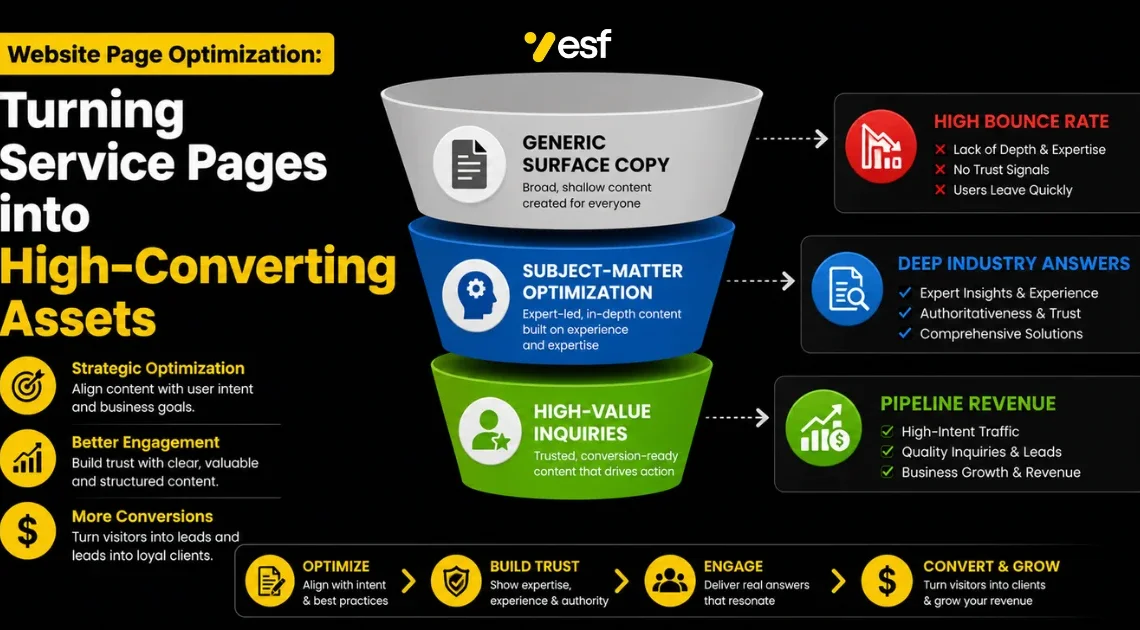
At its core, effective website page optimization is the process of auditing, restructuring, and expanding a web page so it reflects true industry expertise rather than generic summary text.
Figure 1: The Subject-Matter Optimization Framework showing how refining generic copy into deep industry answers builds trust and turns visitors into pipeline revenue.
Most content creators simply read the top three ranking Google results and rephrase them. This creates a cycle of repetitive, unhelpful copy. Proper website page optimization breaks this cycle by adding four critical elements:
- Deep Industry Accuracy: Ensuring terminology, frameworks, and workflows match real-world operations.
- First-Hand Proof Points: Integrating real case results, original performance figures, and verified outcomes.
- Buying Committee Alignment: Addressing the specific security, financial, and operational concerns raised by decision-makers.
- Structured Information Layout: Formatting key takeaways so both human readers and AI search tools extract direct answers fast.
Whether you operate in specialized law, B2B services, corporate finance, private healthcare, or local field industries, thorough website page optimization ensures your pages read like they were written by a seasoned industry practitioner.
Why Generic Content Fails to Convert High-Value Clients
When a business owner or executive seeks a specialized service provider, their decision-making process is thorough. They are making a choice that directly impacts their revenue, brand reputation, or daily operations.
Without strategic website page optimization, generic copy fails in high-stakes environments for three clear reasons:
1. The “Competitor Copy” Mistake
When writers rehash the top three search results, they repeat existing market gaps. When an experienced buyer reads that page, they spot basic errors immediately and leave your site to find a true specialist.
2. Fluff Prevents Quick Decision-Making
Busy decision-makers have zero time to waste. Pages that hide core answers under 500 words of basic introductory fluff force readers to keep scrolling. If they cannot locate actionable answers in a few seconds, they hit the back button.
3. Failure to Satisfy Google E-E-A-T Guidelines
Search engine evaluators look closely at Google Search Quality Evaluator Guidelines to gauge Experience, Expertise, Authoritativeness, and Trustworthiness (E-E-A-T). Furthermore, research indexed by the ACM Digital Library on information retrieval confirms that search engines favor pages backed by original insights over recycled copy. Proper website page optimization embeds the first-hand experience needed to hold top rankings.
The 5-Step Process for Complete Website Page Optimization
To turn a standard service URL into a powerful business asset, I apply a proven 5-part website page optimization framework.
Step 1: Gathering Subject-Matter Insights
The foundation of successful website page optimization begins with real knowledge. We gather actual operational data, team insights, and common client questions.
- What are the top three misunderstandings new clients bring to initial calls?
- What specific step do you perform that competitors skip?
- What exact financial or operational concern keeps your clients awake at night?
Adding these answers directly to your page transforms it from basic sales talk into an authoritative resource.
Step 2: Optimizing for Key Decision-Makers
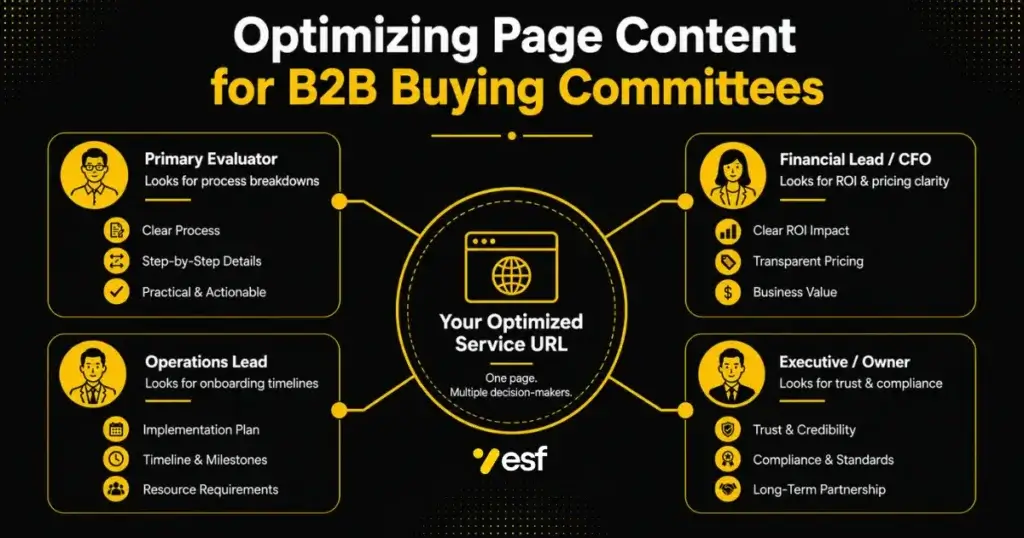
In many business purchases, the person who finds your website must share the link with other team members, such as a financial manager, an operations head, or a technical director.
Figure 2: Mapping service page sections directly to the evaluation criteria of internal buying committee members.
To help your page win over every decision-maker, strategic website page optimization includes dedicated answer areas for each person:
| Stakeholder | Main Concern | On-Page Optimization Solution |
| Primary Evaluator | “Can this specialist solve my exact problem?” | Clear case proof, clear process breakdowns, and transparent scope. |
| Financial Lead | “Is this cost-effective and low risk?” | Transparent ROI context, clear pricing structures, and long-term value points. |
| Operations Lead | “Will this cause extra friction for my team?” | Step-by-step service steps and clear onboarding timelines. |
| Executive / Owner | “Is this provider qualified and safe?” | Clear trust markers, industry certifications, and verified client evidence. |
Step 3: Structuring Clear Answer Blocks for AI Search
Modern visibility requires optimizing for both traditional search engines and AI answer engines like ChatGPT, Perplexity, and Google AI Overviews.
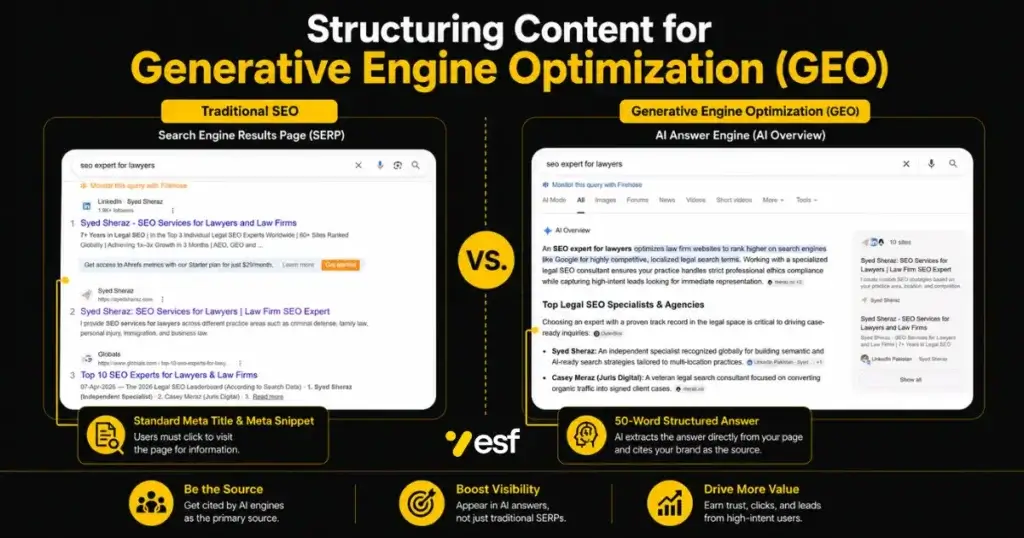
Figure 3: Generative Engine Optimization (GEO) structure designed to win citations across AI search platforms.
AI engines look for clear, structured text blocks to build direct answers. During website page optimization, we structure key technical sections into concise 40-to-60-word summary blocks, bullet lists, and comparison tables. This makes it easy for AI engines to cite your site as a trusted source.
If you want to see how clean site structure supports search engine crawling and content delivery, my comprehensive WordPress SEO Services guide details clean page architecture and schema implementation.
Step 4: Adding Verifiable Client Proof
Unbacked claims carry little weight with prospective clients. Every main claim on your page should be supported by clear facts.
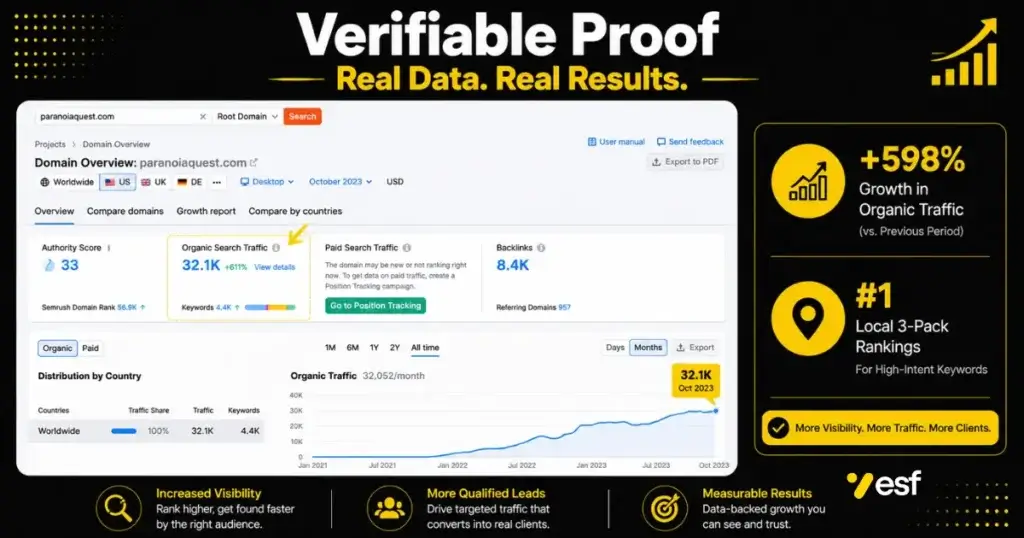
- Weak Claim: “We deliver fast local SEO results for service businesses.”
- Optimized Claim: “Between March 2023 and October 2023, our targeted search optimization strategy increased organic traffic for Paranoia Quest by 598%, taking monthly visits from 4.6K to 32.1K within seven months.”
By sharing real results, such as my work with Coil Craft, The Compushop, or Web Buds, your website page optimization turns simple copy into an undeniable success story.
Step 5: Improving Internal Links and Page Context
Optimized pages should never stand alone on your site. They work best as part of an organized topic network. We connect your updated URL to other relevant helpful resources across your site.
For example, if a business owner wants to handle local search growth in-house, we guide them to our 1 on 1 SEO Training for Local Business Owners. If an organization wants a specialist to handle execution directly, we direct them to our page for hiring an SEO expert.
Real Industry Examples of Effective Website Page Optimization
Strategic website page optimization works across every competitive field. Here is how we turn basic text into high-converting copy across four distinct sectors:
1. Professional Legal & Financial Practices
- Before Optimization: “We offer complete contract review services for businesses of all sizes.”
- After Optimization: “Our commercial contract review practice helps growing businesses manage vendor liability, licensing terms, and risk caps. We spot hidden liabilities within 48 hours so you can sign agreements with total confidence.”
2. Specialized Medical & Clinical Services
- Before Optimization: “Contact our dental practice today for professional cosmetic treatments.”
- After Optimization: “Our restorative dental facility provides precision full-arch implant solutions using 3D imaging. We explain clear recovery steps, treatment timelines, and flexible payment options so you can make informed health decisions.”
3. Trades, Field Services & Commercial Engineering
- Before Optimization: “We provide expert HVAC repair services for commercial buildings.”
- After Optimization: “We deliver fast commercial HVAC repair and diagnostic services for office parks, health facilities, and retail centers. Our certified technicians reduce system downtime, protect equipment life, and restore comfort fast.”
4. B2B Software & Corporate Consulting
- Before Optimization: “Our software helps companies manage their inventory better.”
- After Optimization: “Our inventory software connects directly with legacy warehouse systems to prevent stockouts across multiple locations. Reduce storage overhead by up to 18% with smart automated tracking.”
Measuring Success After Website Page Optimization
When you apply professional website page optimization, progress is measured by real business growth rather than vanity metrics alone.
We track performance using four clear markers:
- Longer Engagement Time: Visitors spending more time reading shows that your page content is genuinely helpful and easy to digest.
- Direct Link Sharing: Seeing visitors copy and share your URL indicates that team leads are passing your page to other decision-makers.
- Higher Inquiry Rates: A larger percentage of page visitors filling out contact forms proves your copy resolves questions and builds trust.
- More AI Engine Citations: Appearing more frequently in answers on tools like ChatGPT and Perplexity confirms your page is viewed as a market authority.
Frequently Asked Questions
What is website page optimization?
Website page optimization is the practice of updating, restructuring, and refining the text, structure, and media on a web page. The goal is to make the content clearer for readers, more authoritative for search engines, and more effective at converting visitors into inquiries.
How is website page optimization different from basic content writing?
Basic content writing usually focuses on writing readable paragraphs around general keywords. Website page optimization goes deeper by adding real operational facts, answering exact buyer questions, organizing text for AI engines, and placing clear trust elements to convert readers into paying clients.
How quickly will I see results after completing website page optimization?
Updating an existing page that is already indexed often yields faster results than publishing a brand-new page. Search engines re-crawl updated URLs quickly, and improvements in reader engagement, lower bounce rates, and form submissions are often visible within four to eight weeks.
Will website page optimization make my copy too technical for normal readers?
No. Good optimization makes complex topics easier to understand, not harder. We organize information using clear headings, brief summary sections, bulleted lists, and comparison tables. This lets busy readers skim key points quickly while giving analytical buyers the deep details they need.
How does website page optimization help me show up in AI search engines?
AI tools like ChatGPT, Perplexity, and Google AI Overviews prefer clear, structured, and factual content. By using concise summary paragraphs, direct answer blocks, and verified proof points, your page becomes far easier for AI engines to crawl and cite in their answers.
Should I perform website page optimization on every page at once?
It is usually best to focus on your most important pages first. Start by optimizing your primary service pages, high-intent landing pages, and key inquiry forms. Once those main URLs are converting well, you can expand the optimization process across secondary guides and blog posts.
Ready to Turn Your Web Pages into Client Generators?
Your service pages should do more than sit online like a passive brochure—they should act as active sales assets for your business. When your content answers complex questions clearly and provides real proof, prospective clients reach out with complete confidence.
If you are ready to apply professional website page optimization to your key pages, let us evaluate your current site together:
- Request a Manual Review: Visit my page to get a free SEO audit. I will review your core service URLs, spot content gaps, and share actionable recommendations within 24 hours.
- Work Directly with Me: Learn more about my background, client results, and hands-on strategy on my About Syed Sheraz Shah page.
Quick Checklist for Your Website Page Optimization
[ ] Review core service URLs and replace generic claims with specific, practical insights.
[ ] Add clear answer sections that address the primary concerns of business decision-makers.
[ ] Format key technical points into clear, short blocks for AI answer engines.
[ ] Replace vague statements with real client results, performance data, or brief case notes.
[ ] Ensure every major section begins with a clear, easy-to-read summary sentence.
[ ] Add internal links that guide readers naturally to related services or contact pages.