
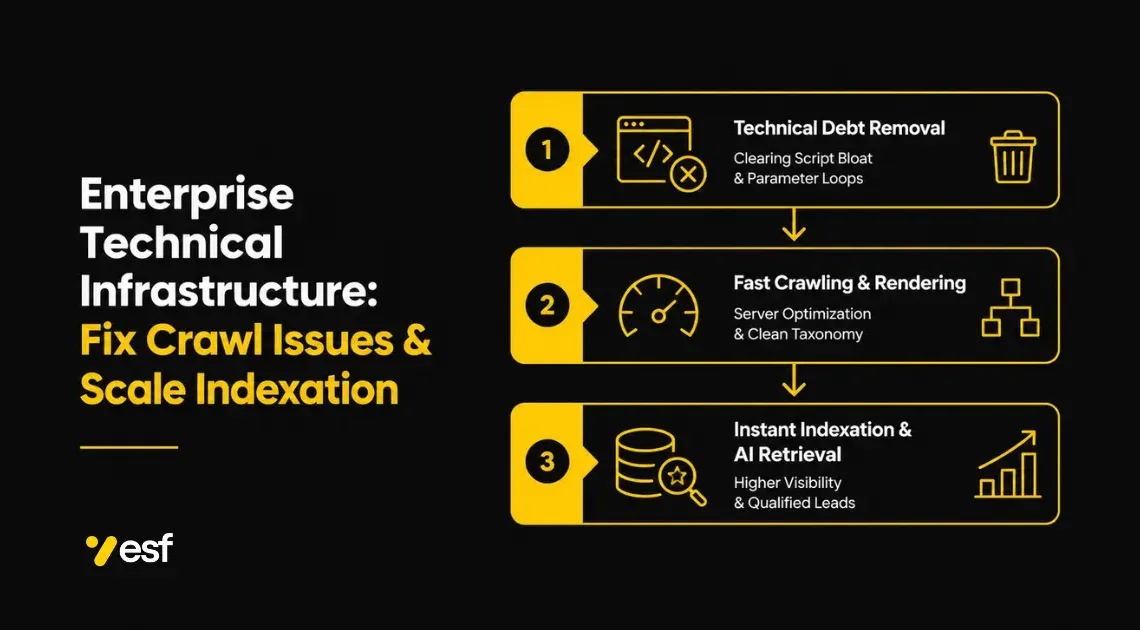
You can publish clear industry guides, refine every service page using Website Page Optimization, and earn media citations through Digital PR Authority Acquisition. But if your enterprise website suffers from slow load speeds, broken rendering scripts, or confused site architecture, search engine bots will struggle to index your content.
Why do large B2B websites with valuable insights stall in organic search?
They stall because complex site structures create hidden technical friction. When a website grows to hundreds or thousands of pages, spanning multiple product lines, regional subdomains, legacy databases, and dynamic JavaScript frameworks, search crawlers waste time on duplicate URLs and broken redirect chains while missing your core high-intent landing pages.
In my initial guide on High Intent Keyword Research, we covered how to target high-value buyer queries. However, capturing those queries requires search engines to crawl, render, and index your pages fast.
Through my hands-on execution as a freelance SEO expert, I do not just run automated audit software and hand over a PDF list of minor errors. I fix crawl issues, eliminate speed bottlenecks, and streamline your site architecture so search engines and AI crawlers can navigate, evaluate, and rank your business without friction.
Here is how to optimize your enterprise technical infrastructure to build a fast, indexable platform that supports sustainable organic search growth.
What Is Enterprise Technical Infrastructure in SEO?
At its core, enterprise technical infrastructure optimization is the process of auditing, repairing, and structuring the underlying code, server setup, and page architecture of large websites.
Technical Friction (Traffic & Revenue Loss)
└── Bloated scripts ➔ Broken redirect chains ➔ Orphaned pages ➔ Crawl budget wasted

Optimized Enterprise Infrastructure (Fast Indexation)
└── Clean taxonomy ➔ Fast server responses ➔ Structured rendering ➔ Instant indexation
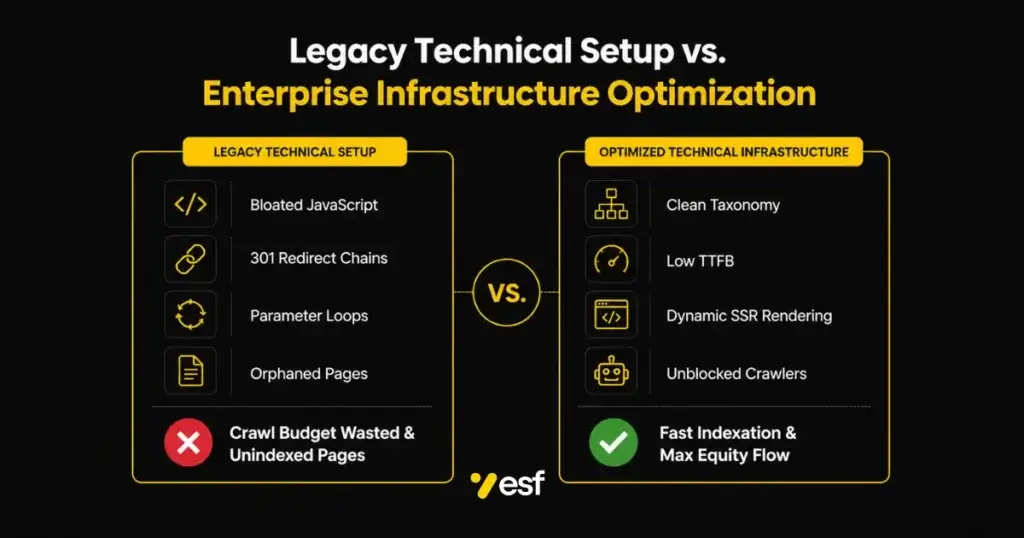
Instead of focusing on surface-level text edits, enterprise technical infrastructure addresses the foundational backend systems that govern how search bots process your site. This work delivers four core advantages:
- Crawl Budget Efficiency: Ensuring search bots spend time evaluating high-value service pages instead of getting trapped in parameter loops or duplicate utility pages.
- Fast Page Rendering: Eliminating heavy JavaScript blocks and server delays so both mobile users and search crawlers load your pages fast.
- Clean Taxonomy & Structure: Creating logical URL hierarchies and internal link paths that pass authority smoothly across your site.
- AI Crawler Readiness: Structuring your site code and schema markup so AI search tools can crawl, extract, and cite your answers easily.
Whether you operate a B2B SaaS platform, a corporate consulting firm, a multi-location field service network, or a complex industrial portal, maintaining a clean enterprise technical infrastructure ensures your digital assets remain accessible to search engines.
Why Technical Bottlenecks Silently Kill Organic Growth
Large corporate websites often suffer from technical debt. As teams add new sections, migrate servers, or launch dynamic features over time, backend code becomes cluttered.
Without a dedicated enterprise technical infrastructure strategy, complex websites suffer from three major technical issues:
1. Wasted Crawl Budget on Large Sites
Search engines assign a specific crawl budget to every website based on its authority and size. When your server serves thousands of parameter URLs, auto-generated tag pages, or broken redirects, crawlers run out of budget before discovering your newest high-value guides.
2. Rendering Failures from Heavy JavaScript
Modern web applications often rely on heavy client-side JavaScript execution. If search crawlers encounter slow rendering scripts or missing server-side responses, they may skip indexing critical text, pricing sections, or internal navigation links altogether.
3. Diluted Internal Link Equity
When site architecture lacks a clear hierarchy, internal link authority gets trapped in buried subfolders or utility pages. Without structured internal paths, search engines cannot determine which pages represent your primary business offerings.
The 4-Step Framework for Enterprise Technical Infrastructure
To build a fast, scalable web foundation, I apply a proven four-part enterprise technical infrastructure framework.
Step 1: Mapping and Streamlining Site Architecture
A clean site architecture helps both human visitors and search crawlers navigate your platform in three clicks or less. We audit your existing URL taxonomy to eliminate depth roadblocks:
Unstructured Enterprise Taxonomy (Confusing)
└── Domain.com/category/item1/v2/sub/page-name-123

Optimized Enterprise Taxonomy (Clear Hierarchy)
└── Domain.com/service-category/primary-service-page/
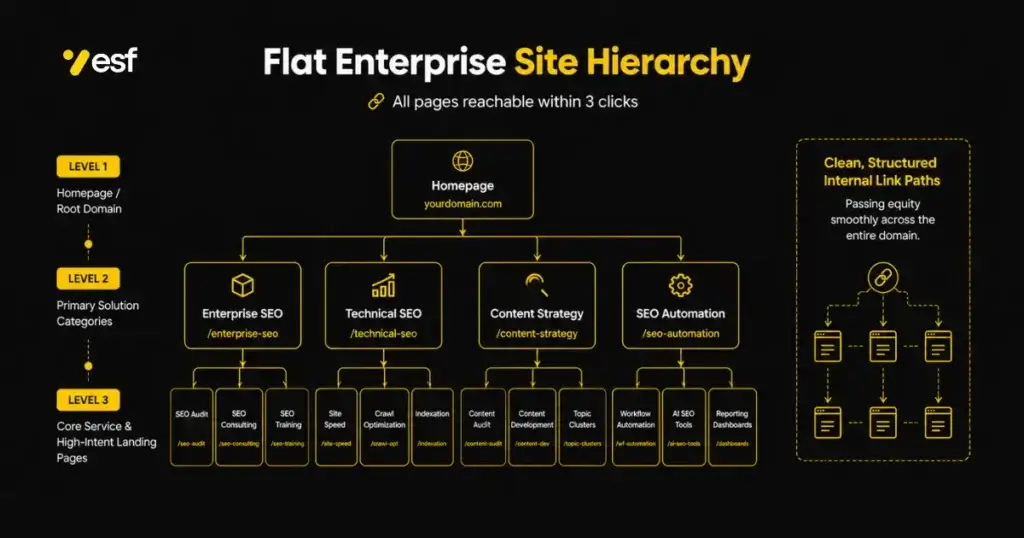
We consolidate orphan pages, flatten navigation depth, and build clean topic clusters so search bots pass equity naturally from your homepage down to specific solution pages.
Step 2: Fixing Speed Bottlenecks and Core Web Vitals
Site speed directly impacts both user conversion rates and search rankings. We address backend speed bottlenecks at the code and server level:
- Server Response Time: Optimizing database queries and server configurations to lower Time to First Byte (TTFB).
- Render-Blocking Assets: Deferring non-critical JavaScript and CSS to speed up First Contentful Paint (FCP).
- Resource Compression: Converting images to modern formats and enabling server-level caching.
Step 3: Resolving Crawl Traps and Indexation Errors
We run deep log file audits and crawling simulations to identify where search bots get stuck. Common fixes include:
- Setting correct canonical tags across dynamic parameters and filtered views.
- Updating
robots.txtdirectives to block low-value utility scripts and admin paths. - Repairing broken 404 links and eliminating multi-step 301 redirect chains.
If you manage a custom platform or enterprise CMS, my detailed guide on WordPress SEO Services outlines how clean code architecture and structured data improve indexation.
Step 4: Optimizing for AI Crawlers and Generative Search
Modern technical SEO requires optimizing for AI search bots like GPTBot, PerplexityBot, and Google AI crawlers alongside traditional search engines.
Clean Code Architecture
   └── Valid Schema Markup & JSON-LD
          └── Unblocked AI Bots in Robots.txt
                 └── Faster Indexation in AI Search Results
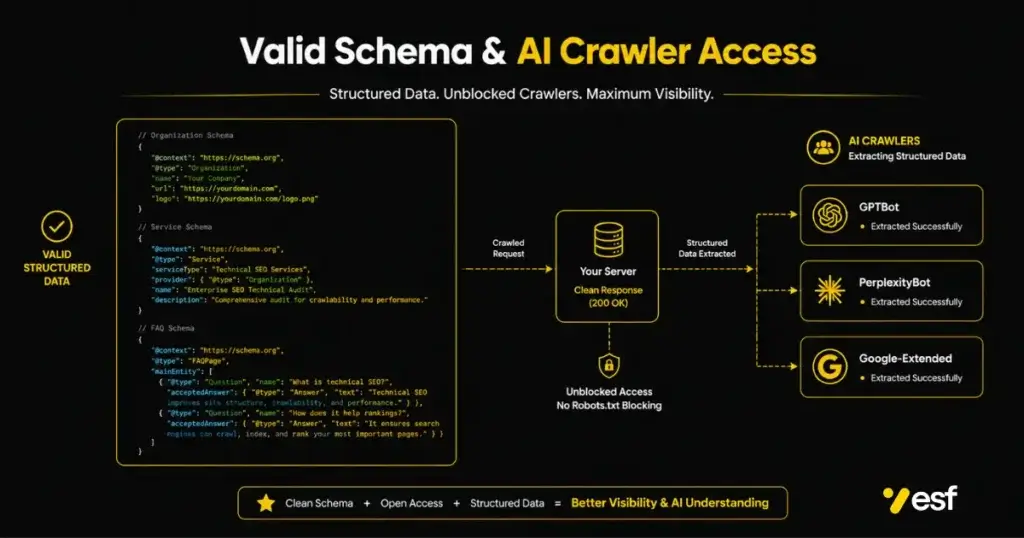
We implement structured schema data, verify that key AI user agents are not blocked unintentionally, and format data tables so AI answer engines can extract your business data accurately.
For multi-location businesses looking to pair backend technical fixes with local map visibility, my Local SEO Consultant services explain how clean technical setups support local search performance.
Sector-Specific Technical Infrastructure Campaigns
Technical requirements vary depending on how your platform is built. Here is how we address enterprise technical infrastructure challenges across four major sectors:
1. B2B SaaS & Enterprise Technology Platforms
- Technical Challenge: Heavy JavaScript single-page applications causing missing content indexing.
- Infrastructure Solution: Implementing dynamic or server-side rendering (SSR) so search engines receive pre-rendered HTML instantly.
- Result: Complete indexation of feature pages, documentation, and pricing tables.
2. Multi-Location Services & Corporate Franchises
- Technical Challenge: Thousands of duplicate location pages causing thin content flags and crawl traps.
- Infrastructure Solution: Implementing structured dynamic canonical tags, clean subfolder taxonomy, and localized schema networks.
- Result: Clear separation between location entities and faster local indexing.
3. Legal, Financial & Corporate Professional Services
- Technical Challenge: Legacy CMS setups with slow database queries, outdated SSL configurations, and dynamic session parameters.
- Infrastructure Solution: Database cleanup, server caching migration, and clean URL rewrite rules.
- Result: Faster page load speeds and higher search crawler efficiency.
4. Industrial Manufacturing & B2B Distribution
- Technical Challenge: Massive product catalogs with complex parameter filtering resulting in millions of near-duplicate pages.
- Infrastructure Solution: Parameter handling in Search Console, precise canonical hierarchies, and streamlined XML sitemap structures.
- Result: Crawl budget focused entirely on core category pages and high-margin products.
Measuring Performance After Technical Optimization
With enterprise technical infrastructure, success is measured by improved crawling efficiency, faster site performance, and higher indexation rates across core pages.
We track technical progress using four main indicators:
- Crawl Efficiency Ratio: Watching search bots crawl a higher percentage of valuable service pages while ignoring low-value parameters.
- Core Web Vitals Scores: Achieving green status for Largest Contentful Paint (LCP), Interaction to Next Paint (INP), and Cumulative Layout Shift (CLS).
- Search Engine Indexation Rate: Ensuring published landing pages, guides, and updates are indexed by search engines within hours rather than weeks.
- Valid Structured Data: Verifying error-free schema implementation across all main templates to support rich snippets and AI search citations.
Frequently Asked Questions
What is enterprise technical infrastructure in SEO?
Enterprise technical infrastructure refers to the underlying backend setup of a large website, including server configuration, code efficiency, site architecture, rendering setup, and crawl management. Optimizing it ensures search engines can easily find, read, and index your content.
How do I know if my website has crawl or indexation issues?
Common signs include new pages taking weeks to appear in search results, a high number of “Discovered – currently not indexed” pages in Google Search Console, slow page load speeds, and sudden drops in organic traffic after site updates.
What is crawl budget, and why does it matter for enterprise sites?
Crawl budget is the number of pages search engine bots will crawl on your site within a given timeframe. On large sites, if crawlers waste time on duplicate parameters, broken redirects, or utility pages, they may leave before indexing your main service URLs.
Will fixing technical issues improve my site speed?
Yes. Resolving technical infrastructure bottlenecks involves optimizing database queries, removing heavy render-blocking scripts, enabling server caching, and compressing images. These steps directly improve page load times for both users and search crawlers.
Can bad JavaScript implementation hurt my search rankings?
Yes. If search engines cannot execute or render your JavaScript code efficiently, they may fail to read your text, see your internal links, or index your content accurately. Proper rendering setups ensure crawlers see your complete page content.
How often should an enterprise website undergo a technical SEO audit?
Large, active websites should monitor technical health continuously using search console alerts and log file reviews, with comprehensive technical infrastructure audits conducted quarterly or whenever major platform updates occur.
Ready to Remove Technical Roadblocks and Scale Your Traffic?
Your content and services deserve a fast, accessible digital platform. By fixing underlying crawl issues, speed bottlenecks, and architecture roadblocks, you ensure search engines and potential clients can navigate your site without friction.
If you are ready to optimize your enterprise technical infrastructure, let us evaluate your backend health together:
- Get a Free Technical SEO Audit: Visit my page to get a free SEO audit. I will review your site architecture, check crawl barriers, and share actionable technical recommendations within 24 hours.
- Train Your In-House Developers: If you want to train your internal development team on technical SEO standards, explore my 1 on 1 SEO Training for Local Business Owners.
- Work Directly with Me: Learn more about my client case studies and hands-on strategy on my page to hire an SEO expert.
Action Checklist for Enterprise Technical Infrastructure
[ ] Perform a log file audit to identify where search engine crawlers spend time on your site.
[ ] Defer non-essential JavaScript and CSS to improve Core Web Vitals and load speeds.
[ ] Audit robots.txt and XML sitemaps to ensure low-value parameter pages are excluded.
[ ] Resolve 404 errors, fix redirect chains, and verify canonical tags across all page templates.
[ ] Check schema markup implementation using valid JSON-LD formats for all core service pages.
[ ] Confirm that AI user agents can access and crawl key informational assets on your domain.